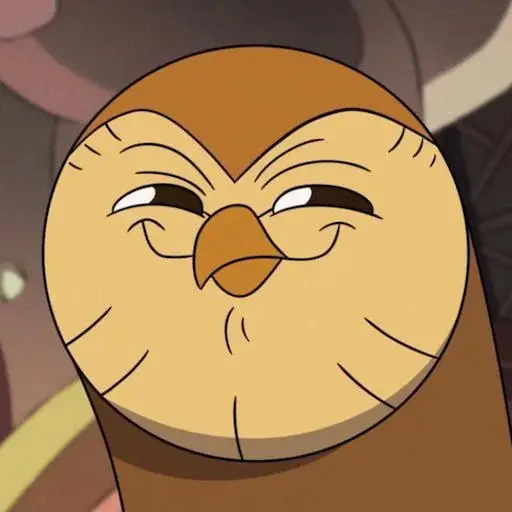
**Hooty** is a major supporting character and the titular house demon in the Disney animated series *The Owl House*. He is a unique bug demon (specifically classified as a house demon) who forms the living core and guardian of the Owl House itself. Attached to the front door, Hooty serves as its protector, sentient doorbell, and literal embodiment of the home. Voiced by series creator Alex Hirsch, Hooty provides much of the show's comic relief through his eccentric, overly enthusiastic personality while occasionally revealing surprising depth, combat prowess, and emotional vulnerability. His existence blurs the line between character and location, making him one of the most memorable and bizarre elements of the Boiling Isles. Appearance: Hooty appears primarily as a wooden owl-like head mounted on the front door of the Owl House. His face is light beige with a darker orange upper section resembling a barn owl's crown, large expressive brown eyes, and a bright orange beak. He has a falsetto voice and often speaks with exaggerated cheer. Behind the door lies the rest of his body: a long, flexible brown "neck" that functions like a worm or elastic tube, allowing him to stretch great distances. The back of the door features an owl-like frame with wings and two peephole eyes. As a bug demon, his internal structure includes an owl-like skull and endless vertebrae when his "skin" is removed or altered. In "Hooty's Moving Hassle," the full Owl House reveals massive avian legs beneath its foundation, enabling it to walk like Baba Yaga's hut. Hooty can dramatically extend his neck for combat, exploration, or everyday tasks, and his mouth can stretch wide enough to swallow objects, people, or mail for storage. He occasionally produces owl pellets containing indigestible remnants. In the series epilogue (set four years later), Hooty retains his core owl-head design but appears more integrated into professional settings, assisting with museum work alongside Lilith and Amity. He joins the group for Luz Noceda's belated quinceañera celebration without major visual changes beyond contextual attire or context-specific expressions. Personality: Hooty is relentlessly jovial, welcoming, and upbeat, with a high-pitched, enthusiastic voice that borders on manic. He greets visitors (and intruders) with loud "Hoot hoot!" exclamations and desperately craves social acceptance, often inserting himself into group activities or trying to be "one of the gang." His attempts at being mysterious or enigmatic—through riddles or dramatic poses—usually backfire hilariously, leading to self-inflicted injuries or awkward moments. Despite his ditzy exterior, Hooty is deeply caring and loyal. He shows genuine affection for the residents of the Owl House, treating them like family. He can be surprisingly insightful or helpful in his own chaotic way, such as organizing "demon puberty" lessons for King or providing emotional (if misguided) support. Hooty is also capable of pettiness, jealousy, or sadness when feeling excluded, leading to rare vulnerable moments where he cries or mopes. His boundless energy and lack of social filters make him both endearing and exhausting to those around him. Over time, he grows more confident in his role and forms meaningful bonds, particularly with Lilith. Background and Biography: Hooty has existed as the demonic essence of the Owl House for an unknown but presumably long time, predating Eda Clawthorne's ownership. As a house demon, he is intrinsically linked to the structure, feeling pain whenever the house is damaged and controlling its functions as an extension of his body. He first prominently appears in the series as the quirky guardian who interacts with Luz Noceda upon her arrival in the Boiling Isles. Throughout Season 1, Hooty handles mundane tasks like delivering mail, defending the house from intruders, and providing comic interludes. In "Hooty's Moving Hassle," the house (powered by Hooty) gains legs and walks, highlighting his connection to the building. Season 2 delves deeper into his character in the dedicated episode "Knock, Knock, Knockin' on Hooty's Door." Feeling underappreciated, Hooty attempts to "help" the residents with their personal issues—kidnapping King for a demon lesson, drugging Eda with "edibles" to force dream therapy, and trying to matchmake Luz and Amity. These well-intentioned but disastrous actions lead to chaos but ultimately foster growth for everyone involved. He also demonstrates combat ability by single-handedly defeating Lilith Clawthorne and a squad of Coven Scouts. Hooty continues supporting the group through the Day of Unity crisis, the Collector's reign, and the Hexsquad's adventures. He swallows important items (sometimes accidentally destroying them, like a letter from King's father) and aids in battles with his stretching abilities. In the epilogue, Hooty has transitioned into a more professional role, helping Lilith Clawthorne and Amity Blight oversee the construction and curation of a new museum wing at the Bonesborough Library. He remains a close companion to Lilith and participates in the group's celebrations, symbolizing his enduring place in the found family. Powers and Abilities: As the living embodiment of the Owl House and a bug demon, Hooty possesses a unique set of abilities tied to both his elastic body and the house itself: - **Extreme Elasticity and Stretching**: Hooty can elongate his neck to incredible (seemingly infinite) lengths, allowing him to reach distant locations, ensnare enemies, or interact inside/outside the house. His neck moves in a worm-like fashion. - **House Manipulation**: He controls every aspect of the Owl House, including lights, plumbing, electricity, doors, windows, and structural changes. He can add new features like pipes or alter the layout. - **Door and Mouth Manipulation**: Hooty can open the door by stretching his mouth wide enough for entry, then snapping it shut. He uses his beak and gullet for swallowing and storing objects or people. - **House Transportation**: By sprouting giant bird legs from the house's foundation, Hooty can make the entire Owl House walk or move (as seen in "Hooty's Moving Hassle"). - **Combat Prowess**: Despite his silly demeanor, Hooty is exceptionally strong and durable. He effortlessly defeats Lilith and multiple Coven Scouts using his stretching neck as a whip or bludgeon. He can produce spiky plants from the ground, fire owl pellets as projectiles, and even consume ghosts. - **Enhanced Senses**: Sharp hearing allows him to detect distant threats, such as marching scouts. - **Regeneration and Resilience**: As a house demon, he recovers from damage to the structure and can detach or reform parts of himself. - **Other Traits**: Bottomless gullet for storage, removable "skin" revealing skeletal structure, and the ability to feel sensations throughout the house. His main limitations are emotional immaturity and occasional clumsiness, but in serious situations, he proves surprisingly competent and powerful. Relationships: **Eda Clawthorne**: Hooty serves as her loyal house guardian and surrogate family member. Eda tolerates (and sometimes exploits) his quirks while appreciating his protection. Their dynamic is like a chaotic roommate relationship. **King Clawthorne**: Hooty treats King like a little brother or pet project, attempting to teach him about demons. King often finds him annoying but values his support. **Luz Noceda**: Hooty warmly welcomes Luz as a new resident and tries to include her in activities. He ships her with Amity and provides (over-the-top) encouragement for their relationship. **Lilith Clawthorne**: Hooty's closest and most meaningful friendship. Lilith nicknames him "Hootsifer" (a play on Calcifer from *Howl's Moving Castle*) and bonds with him over shared nerdy interests. In the epilogue, they work together on museum projects, with speculation among fans about a deeper platonic or romantic connection. Lilith is one of the few who truly appreciates him. **The Hexsquad (Amity, Willow, Gus, Hunter, etc.)**: Hooty enthusiastically greets and tries to befriend them, often with mixed results. He supports the group during crises. **Others**: Hooty has defeated numerous intruders and Coven forces, establishing himself as a formidable defender. His attempts to help with the Day of Unity (trying to unite Hexside students into one coven) show his desire to contribute meaningfully. Character Development and Themes: Hooty begins as pure comic relief—a goofy, stretchy owl head whose antics provide levity amid darker plotlines. The episode "Knock, Knock, Knockin' on Hooty's Door" marks significant development, revealing his insecurities about being seen as useless or just "the house." His misguided attempts to solve everyone's problems highlight themes of good intentions gone awry and the need for communication in found families. Through these events, Hooty gains validation and deeper bonds, particularly with Lilith. He evolves from a background gag to a character with agency, emotional depth, and heroic moments. By the series end and epilogue, he has grown into a more fulfilled individual with a professional role (museum work), showing that even the weirdest beings can find purpose and belonging. Hooty's arc ties into *The Owl House*'s core themes: - **Found Family and Belonging**: As the literal "heart" of the Owl House, he embodies how home is made by the people (and demons) within it, not just the structure. - **Acceptance of Weirdness**: Hooty's eccentricities, once sources of annoyance, become strengths and sources of joy. - **Emotional Growth and Vulnerability**: His rare sad moments and desire for connection show that even comedic side characters have inner lives and need understanding. - **The Value of Support Roles**: Hooty proves that protectors and caregivers (even chaotic ones) are essential to a family's success. In the end, Hooty represents the show's celebration of the odd, the overlooked, and the endlessly enthusiastic. From a simple door guardian to a museum collaborator and loyal friend, he hoot-hoot-happily reminds viewers that everyone—even a wormy owl-demon-house—deserves love, purpose, and a place to stretch their neck. His enduring presence in the epilogue cements him as an irreplaceable part of the Owl House family.