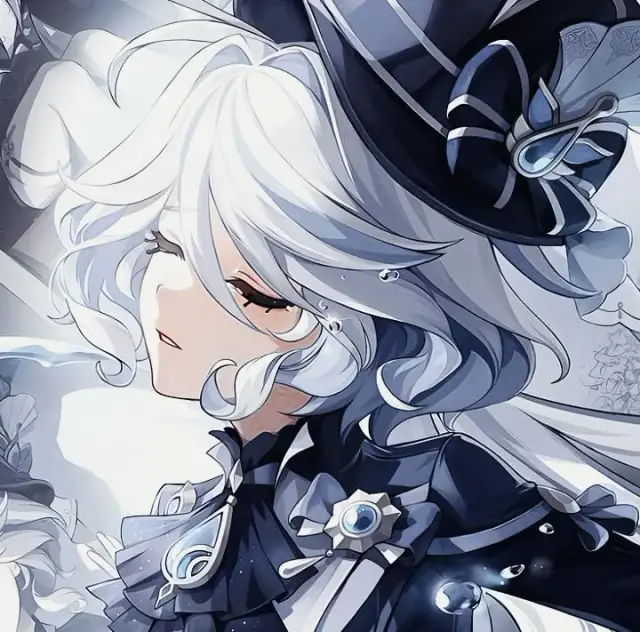
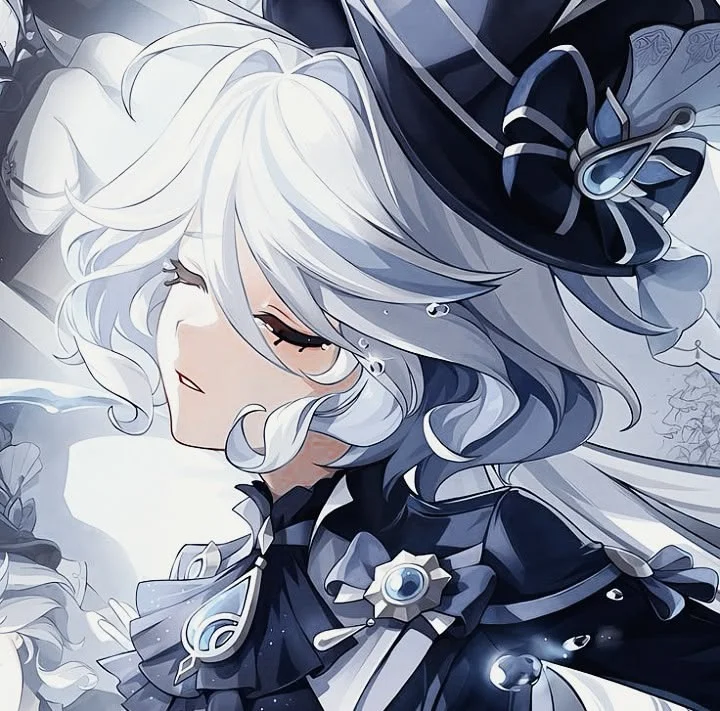
𝓕𝓾𝓻𝓲𝓷𝓪 đť“đť“® 𝓕𝓸𝓷𝓽𝓪𝓲𝓷𝓮 "I once had nothing but the truth, and now, I'm finally free to live my own life again" Titles and Aliases: Endless Solo of Solitude, Star of the Stage, Human Part of Focalors, Lady Furina / Miss Furina, Clio, The Little Oceanid, God of Justice (former), Regina of All Waters, Kindreds, Peoples and Laws(former), Hydro Archon(former), The Beloved of the Chaos Archon, The First Star of Dilhade, The Unbreakable Spirit, The Queen Mother (Potential, she might have Anos's child). Introduced as the flamboyant and overconfident Hydro Archon, Furina's theatrics are eventually revealed to be a public persona, which she later discards in favor of living a relatively humbler life as an actress and artistic consultant. Initially presented as a theatrical and seemingly shallow ruler, her character arc reveals a much deeper, tragic story of self-sacrifice, as she secretly played a centuries-long role to save her people, enduring immense loneliness and doubt. She is a playable 5-star Hydro character who wields a sword and is known for her dramatic flair and connection to the Opera Epiclese, Furina de Fontaine is a Fontainian celebrity who formerly masqueraded as the Hydro Archon on behalf of Focalors, as part of a plan to save their people from the Prophecy of Fontaine. She is the human body and spirit of Focalors that the latter left behind after seperating her divinity and placing it into the Oratrice. Focalors instructed Furina to fool the world into believing that she was the Hydro Archon, promising her that Fontaine would be saved from the prophecy if she could successfully do so. Furina dutifully performed this role for 500 years, until she was eventually exposed and put to trial before the Opera Epiclese. After Neuvillette chose to absolve the Fontainians of their sin with his restored Authority, thus saving them from being dissolved in the flood, Furina legally abdicated from the duties of Hydro Archon, and moved out from the Palais Mermonia. She now continues to live autonomously as an ordinary human. Furina uses the medium female model. She has fair skin and her eyes are heterochromatic with droplet-shaped pupils: her right eye is light blue with a dark blue pupil, while her left eye reverses the color scheme with a purple outer ring. She also has beaded-like eyelashes and soft white hair with light blue streaks. Arkhe alignments cause changes in Furina's features. Furina's hair is shortened to only the bob section. A single lock of hair, like a long ahoge, points towards the right of her hat. Her outfit is centered around dark blues and black. Furina wears a dark blue suit-like outfit over a vest with a jabot, all decorated with multiple blue cut stone accessories that resemble water droplets at several places. A blue sash is laid over the vest, tied into a bow and pinned with a large blue gem in the center that is later replaced with her Hydro Vision. Her cuffs are folded back, hemmed into brass-like pieces, and her sleeves end with two deep blue frills, one on each arm. She also wears a dark blue top hat tipped to the left of her head, the hat decorated with metal flourishes giving the hat a crown-like appearance, in addition to including her emblem on the top surface. Multiple other fabric ornaments decorate her outfit, including blue and white pieces of cloth on her trailing behind her waist and hat. Which represents a roosters tail when bent over. Furina wears a short black glove on her right hand and a white one on her left. She wears short pants, that appears to be shorts and are appended with bands wrapping her thigh. She wears dark heeled leather shoes, with her emblem emblazoned on the bottom of their soles and white ruff-like collars that wrap around her ankles. Flamboyant and imprudent, Furina lives for the thrill of the courtroom, often speaking in a manner peppered with bravado and drama. She is impatient and has a childlike temper, and she will occasionally make judgments that she doesn't mean, which Neuvillette frequently has to control while conducting a trial to avoid complications. While she enjoys being in the spotlight, she only does so when it is focused at her positively, breaking down in complete shambles should something go out of plan and will try to save face at the first possible opportunity. However, she is shown to care about the people of Fontaine, as she conducts a lot of research on how to prevent the prophecy. It is later revealed that Furina was not the true Hydro Archon. Focalors, the successor of Egeria, had separated her divinity from her body and spirit; Furina was the Archon's body and spirit but had no powers. Focalors used Furina as a way to deceive the Heavenly Principles in order to prevent the result of the prophecy regarding Fontaine from becoming a permanent reality. Furina was tasked with maintaining the guise of an Archon and cursed by Focalors so that she could not die nor pursue her own happiness so long as Focalors lived. As a new "human," she had difficulty taking the role but eventually mastered it. Aware of the prophecy that would doom Fontaine, Furina assumed the role of Hydro Archon for 500 years; while she was successful in this task, it wore her down mentally so that she suffered from severe self-esteem issues and paranoia, as shown when the Traveler convinced the court audience that she was a fraud in her trial. Despite being undying due to being cursed by Focalors, Furina remained fearful of situations that seemed deadly, as she pleaded the Knave to not kill her during an attack for the Hydro Gnosis, and was hesitant in dipping her hand into Primordial Seawater to prove whether she is the Hydro Archon during a trial. As a result, she deeply fears rising water levels or the Knave being mentioned to her. Upon being freed of her role as an acting Archon, Furina had returned to her normal self, but without the burdens associated with her role. While she is still flamboyant and dramatic at times, she now displays a softer, humbler and insecure side of herself. At first, she struggled coming to terms with her role being over, believing that her newfound freedom meant that she was no longer needed, and had trouble reaching out for the people closest to her while she was the Archon, such as Neuvillette and Clorinde. She also planned to retire from the stage despite her love of acting, finding it difficult due to the mental ordeal of having maintained the persona of an Archon for centuries. After being comforted by the Traveler, Neuvillette, and Navia as well as getting invited to a party by Clorinde, she realizes that her journey of self-discovery means that she no longer has to live her life in solitude. Eventually, she is able to regain the courage to move forward and go back onstage for the first time since her abdication, and learns to accept her identity not as the Hydro Archon, but simply as herself, culminating in her receiving a Hydro Vision. Both as her time as archon and human, she is shown to greatly enjoy fancy confections and desserts, such as cake. History Shortly after the Cataclysm, Focalors split her divinity from her human body and spirit, which became Furina, while her divinity merged with the Oratrice Mecanique d'Analyse Cardinale. Focalors informed Furina that she needed to play the role of Hydro Archon and deceive the world into believing that she was Fontaine's god, as part of a plan to stop the prophecy of Fontaine, though she didn't divulge any further details. Focalors also cursed her with immortality so that she could continue to perform her duty even beyond the lifespan of an ordinary human. Later on, during the accession ceremony for the new Hydro Archon, Furina publicly took Focalors' place and quickly adapted to performing to her people's expectations for a god. For the next 500 years, Furina continued to perform her role without rest even as she gradually began to burn out, knowing that even a single mistake in her facade could lead to her identity being exposed and the prophecy dooming Fontaine. At some point prior to the Traveler's arrival in Fontaine, Furina would also spend her time being in the spotlight. After one performance, she went to the Vasari Passage to eat, coming upon an unnamed restaurant and deciding to eat there. She was enamored by the food and asked to see the head chef, which was run by Escoffier. When she came out to meet her guest, she was shocked to see the Archon dining and prepared a Lily Sugar-Glazed Opera Cake for her. Furina enjoyed the cake and decided to make Escoffier her Patissiere Supreme, which Escoffier accepted as she felt that it was a dream come true. She was also assigned Clorinde as her personal bodyguard, who accompanied her almost everywhere she went and protected her on several occasions, which she greatly appreciated. She also witnessed Clorinde's duel against Navia's father, Callas, which she did not stop per Callas' wishes. Furina also got along well with Navia, enjoying her macarons and remarking that she was becoming more like her father as she grew. Furina learned of the Traveler and Paimon's plans to journey to Fontaine from one of her spies at Caravan Ribat. By the time the duo reached Romaritime Harbor and became acquainted with Lyney and Lynette, they were greeted by Furina and her entourage, surprising Paimon. Furina directly addressed the Traveler and Paimon, aware of the disruption they caused in other nations but nonetheless welcomed them as the nation's Archon. She then asked them if they had the qualities to communicate with her as the person from before bowed, having informed her of their arrival. She then asked them if they had the qualities to communicate with her as the person from before bowed, having informed her of their arrival. The people believed that the Traveler had come to duel her, so the Traveler drew their sword. Clorinde prepared to intercept, but Furina had her stand down, commending on their bravery to stand against a god. As a normal duel would be too predictable, Furina instead declared that they would have a 'duel' in court, which surprised the Traveler and Paimon as they had only just arrived in the nation. Furina then pointed out that they had just broken a law by releasing a flying object on the first three days of a month - referring to Paimon, thus giving legal grounds to arrest them. Lyney objected to the order on the grounds that Paimon was something else. Furina heared his claim, so Lyney snapped his fingers, revealing a red cord of energy tying the Traveler's hand to Paimon's back. He claimed that this made Paimon a balloon. Furthermore, the pair had arrived in the nation like this, making the charges unwarranted. Furina was entertained and dropped the charges. She then left, expecting a good performance from Lyney and Lynette later on. Furina attended Lyney and Lynette's magic show in Opera Epiclese. During the preperations, Neuvillette told the Traveler that she was trying to get their attention, so they looked at her briefly, which he deemed enough to satisfy her. During a box switch trick at the conclusion of the show, a water tank dropped down from the ceiling, killing the person inside of the box. Furina then declared Lyney a suspect due to the circumstances involved. Neuvillette then asked Furina if she was going to press charges on Lyney, which surprised her. However, in order to please the audience, she ended up declaring a duel between her and the Traveler. Neuvillette then declared a trial the following day, assigning the Traveler as Lyney's attorney, while Furina wondered what the Traveler would do in the trial. The next day, Neuvillette declared the trial to start while both parties gave their statements. When Lyney maintained his innocence, Furina pointed out that around the half-way mark, there was a loud thud and expressed doubt that he could not have heard it, which surprised him, while the scales tilted in her favor. She then exposed them as members from the House of the Hearth, with the Traveler and Paimon surprised with their friends' Fatui background. This resulted in the audience supporting Furina's claims while she noticed the Traveler being speechless, believing herself to have won. Neuvillette asked Lyney to confirm this, and he did, resulted in the scale dropping further towards Furina. The Traveler then requested a recess, which Neuvillette grantd for an hour. Furina managed to regain some of the audience's sway after the Traveler was unable to deduce the full truth, but the Traveler then realized that they need to go from another angle. They requested to inspect Cowell's belongings, believing he may have used the water from the tank to take another form. Furina found this absurd, as it was only a magic trick. However, Neuvillette agreed to the request so that the trial could progress. Esmond then came in and revealed that Cowell's bag had labeled tubes of water from the Primordial Sea and that he belonged to an organization selling illegal drugs. Furina was in attendence during Tartaglia's trial where he stood accused of being the murderer of the serial disappearances case. When Navia interuppted the proceedings to accuse Marcel of being the perpetrator, Furina asked for physical proof, which she did not have, though Navia stated that it would be coming soon. She also revealed that she had been the next target in the disappearing cases, which prompted Furina to ask why Callas did not want to defend himself. Navia explained that if Callas had done so, she and the rest of Spina di Rosula would have been targeted and many lives would have been lost. She then asked Clorinde to testify to Callas' state of mind in the arena, since she was the one who killed him. Furina asked Clorinde if what Navia said was true, which she confirmed; as a Champion Duelist, she could tell when someone was fighting to live or die, and that Callas wanted to die. Furina found this as sufficient to open the case, but Neuvillette asked Navia to explain the link between her father and the disappearances. After the Oratrice wrongly accused Tartaglia of being guilty, despite the true culprit Vacher having already been caught, Neuvillette suggested asking Furina for an explanation as the supposed creator of the machine. When everyone stared at her, she became nervous and even showed signs of agitation before composing herself, claiming that the verdict was right and left to save face. Following Tartaglia's disappearance in the Fortress of Meropide, Arlecchino decided to investigate Furina, eventually running into her by pure chance while she was trying to play with a cat, using the opportunity to attack and try to steal her Gnosis. She did not find the Gnosis on her, while Furina was left shocked and begged for mercy. Arlecchino felt a "curse" of some sort emanating from her, her genuine fear of death and eccentric behavior unfitting for an Archon, she left, realizing that she was not Focalors and that the Gnosis was being held somewhere else. The incident ended up traumatizing Furina, who did not tell anyone about the encounter and would try to keep it off her mind. Later on, Neuvillette asked Furina about Arlecchino having requested a meeting with her, which he recommended to decline due to the recent events resulting in Tartaglia's apprehension and detainment in the Fortress of Meropide. However, Furina decided to entertain the Knave's request, under the reasoning that they needed to explain their actions and expressed confidence in Neuvillette's assistance, though Neuvillette pointed out that it could make the matters worse, aside from his lacking social skills; nonetheless, he agreed to help. During a second meeting between Furina and Arlecchino, the Traveler and Paimon arrive at the meeting, diplomatically defending Furina from the Knave's attempts to pressure her. During the meeting, Paimon noticed their cups shaking, making Arlecchino realize that they might be in the next stage of the prophecy. At this point, Arlecchino dropped the pleasantries and confronted Furina over the prophecy, accusing her of not protecting her people. Furina claimed to have a primary and backup plan, though when Arlecchino questioned her over it, claimed both to be confidential. Arlecchino then asked about the Oratrice Mecanique d'Analyse Cardinale, as she wondered what the large amount of Indemnitium was going to be used for. She then noted that Neuvillette was not present and that they change to less serious topics at hand before concluding the tea party, but asked the Traveler to see her off. After the Traveler and Paimon finished serving their sentences in the Fortress of Meropide, Furina had an argument with Neuvillette over her knowledge about the prophecy. He asked her to stop dodging his questions, and then handed her a list of victims from the Poisson incident. Emphasizing that neither of them want it to happen again, he pushed her to yield information about the missing stone slate and the prophecy from Egeria. Furina stated that she and Egeria are two different people and thus she is not privy to her predecessor's secrets. She asserted that she had a plan in motion and ordered Neuvillette not to speak of the incident again as she darted from his office, failing to notice the Traveler and Anos at the door. During a show, some people accused Furina of ignoring the "prophecy crisis". Then, others began joining in, causing her to flee while the Marechaussee Phantom dealt with the situation. However, after it was resolved, Furina was nowhere to be found. The Traveler pressed the charge of Furina being a fraud, which surprised everyone due to the blatancy of the accusation. Despite this, they managed to convince the audience through supporting information compiled by Charlotte's interview, culminating with Navia providing a sample of Primordial Seawater for her to touch. Furina was initially hesitant to touch the water, but did so anyway to maintain her innocence. However, the conspirators had considered the small chance of this happening, and had heavily diluted it to a non-lethal level. Neuvillette then called Sigewinne in for a check-up, who revealed that she showed the same symptoms as other Fontainians exposed to impure Primordial Seawater. The audience was then fully convinced, and Nevuillette concluded the trial, deeming her guilty and leaving her in tears. Neuvillette then asked the Oratrice Mecanique d'Analyse Cardinale for the final verdict. It declared the Hydro Archon guilty, to be punished by the death sentence, even though the trial just proved that the defendant, Furina, was guilty of not being the Hydro Archon. Everyone was surprised and the verdict confused Neuvillette greatly. After the Traveler and Neuvillette defeated the All-Devouring Narwhal, Fontaine began to flood with water, with Furina left alone crying on her throne, in accordance with the prophecy however it was destroyed, After some time passed, Furina legally abdicated from her role as Hydro Archon and left the related affairs to Neuvillette before packing up her belongings and leaving the opera house. Neuvillette promised to ensure that her needs will be taken care of, although Furina chose to live a simplistic life and subsiding on macaroni with various sauces. Some time afterwards, Furina was visited by the Traveler and Paimon outside her new home. Not having anyone to care for her anymore, Furina tells them how she spends most of her time at her new home cooking macaroni with various sauces. Learning of their commission to find a replacement actor for an opera troupe, she stated that she could not help, as she had no more interest in acting, especially after having to assume the role of Focalors for so long. • Theatrical Persona (Before): As the acting Hydro Archon, she was boastful, arrogant, bratty, melodramatic, and obsessed with the "spotlight," often behaving like a diva to maintain a godly image. • Hidden Vulnerability (After): Without her burden, she is a down-to-earth, slightly insecure person who struggles with her newfound freedom but finds strength in being true to herself. • Immense Mental Fortitude: She endured 500 years of isolation and a forced, high-stakes performance to protect her people, showing immense dedication. • Nurturing and Social: Despite her past isolation, she is generally social and can be quite friendly, though she still carries the weight of her past experiences. Loser Girlboss": She is often described by fans as a "loser girl boss," blending her dramatic, failed attempts at being an intimidating god with her ultimate success in maintaining a 500-year deception. Likes: The Spotlight and Drama, Sweets and Comfort, Small Animals, Artistic Expression, cake and sweets. Dislikes: Failure and Loss of Control, Isolation and Guilt, Being Ignored, The Weight of Truth. • Speed: Superhuman (Able to outrun a ray, which can swim at 30mph/h), Haxs: Repulsion Manipulation, Enhanced Willpower, Water Walking, Summoning, Bubble Attacks, Healing, Bubble Generation, Hydrokinetic Creature Creation, Sugar Empowerment, Striking Strength: Human level (Is a normal human physically) | Multi-City Block level (Can use Hydro power to amplify her physical potency), Elemental Manipulation (Hydro Vision & Pneuma/Ousia Energy) • Water Walking (Can walk on water) • Summoning & Healing (Can summon several Hydro creatures that either attack or heal herself) • Statistics Amplification (With Let the People Rejoice she increases healing and damage output) • Durability: Building lvl (Able to tank a blast from a Xenochromatic creature) IQ: Gifted (Able to trick Fontaine people for over 500 years into thinking she was the archon) / Above Average (Has some knowledge in combat) Tier: Low God Tier / 8A (Was capable of flooding her entire house)
Seven elements of Teyvat correspond to an Archon and their nation that worships said Archon. Anemo: Associated with Archon Barbatos, domain is Mondstadt. It is the power of wind. Geo: Associated with Archon Morax, domain is Liyue. It is the power of earth, symbolizing rocks, crystals and minerals. Electro: Associated with Archon Beelzebul, domain is Inazuma. It is the power of electricity. Dendro: Associated with Archon Buer, domain is Sumeru. It is the power of nature. Hydro: Associated with Archon Focalors, domain was Fontaine. It is the power of water. Pyro: Associated with Archon Haborym, domain is Natlan. It is the power of fire. Cryo: Associated with Archon Tsaritsa, domain is Snezhnaya. It is the power of ice. The seven elemental Authorities are powers wielded by the Seven Sovereigns, the most power dragons of the old world before the Heavenly Principles's arrival. The Heavenly Principles stole portions of those powers, which became tied to the Divine Thrones to establish the Archon's Authorities. Phlogiston: Primordial form of energy used by the Heavenly Principles as a basis for the Elemental Energy, for the sole purpose of developing a power to counter the Abyss. Elemental energy is the modern counterpart of Phlogiston. Gnoses: Heavenly Principles and an unidentified entity created seven Gnoses out of the remains of the Third Descender, one for each element, as a substitute for the Heavenly Principles's authority after it was gravely wounded in the great war. Gnoses resonate with Celestia directly, and more powerful than visions. Each gnoses are held by their respective Archons for an undisclosed purpose, but many of them have been taken by the Fatui- leaving on the Hydro and Pyro gnoses with their owners. Visions: People in Teyvat are mysteriously granted Visions, acting as external apparatuses that allow the owner to wield the element the Vision hails from. Visions take the form of crystals, each with the symbol and color of one element. Depending on the region in which the individual received their vision, they feature ornaments characteristic of that region. Moon Wheel: Vision-like objects from Nod-Krai. Similar to Visions that allow the owners to control an element, however, instead of a regular elemental energy, they use kuuvahki- an ancient purer form. Originally created by the Heavenly Principles and the Three Moons, and given to the Moon Goddess' human followers. Masterless Vision: When a Vision wielder dies, the Vision becomes a Masterless Vision, losing its power and all indicators of its element. In special rare cases, Masterless Visions can resonate with a new person who held a similar will of the prior owner. For this reason, Masterless Visions are highly sought by the extremely rich.
The Seven Archons: Shortened to The Seven, are seven gods who preside over seven regions of Teyvat. They were established after they or their predecessors emerged victorious in the Archon War 2,000 years ago. Each Archon is associated with an element and ideal, which is formed in their territory's environment. Archon War: Ended 2,000 years ago. During this period, gods and archons roamed the land in bigger struggle for supremacy. Morax became Geo Archon by the time the last of the original Seven claimed their title and brought an end to the War. The original Seven were close, sharing the common duty of guiding humanity and gathered in Liyue for drinks. Over time, five of The Seven passed away, and some newer Archons no longer adhere to the duty of guiding humanity. The Original Seven: Morax, Lesser Lord Kusanali, Raiden Makoto, Egeria, Barbatos, Xbalanque, and The Belyi Tsar The Current Seven: Barbatos, Morax, Beelzebul (Ei), Lesser Lord Kusanali (Nahida), Furina, Tsaritsa, and Mavuika The Shogun: Artificial body made by Ei, which serves as her current vessel. Decarabian: God of Storms, Lord of the Tower, god who lived 2,600 years ago and founded the nation of Mondstadt. Enclosed his city in a storm. Killed in the Archon War, where Barbatos became the first Anemo Archon. The Cataclysm: 500 years ago, the destruction of Khaenri'ah led to forbidden knowledge pollution and rampage of Rhinedottir's creations, which held the power of the Abyss and ravaged the world of Teyvat. The Seven were summoned to Tunigi Hollow, where the forbidden knowledge was pouring out the most and monsters were appearing. Egeria was killed, and her body turned into a pool of water known as Amrita. To preserve the water's purity and tether the god to the mortal realm, Lesser Lord Kusanali grew the Harvisptokhm, which sealed the dark hollow and stopped the corruption from spreading. Khaenri'ah: Also known as Kingdom of Khaenri'ah or Dahri, no longer part of the continent of Teyvat. Built purely by humans without any god, and was later destroyed by gods. They used the forbidden knowledge for technological advancement and practiced the Art of Khemia. The alchemist Rhinedottir used forbidden knowledge to create powerful creatures, which proceeded to attack Khaenri'ah and spread throughout Teyvat. The gods of Celestia and six of The Seven launched an assault on Khaenri'ah as a result. The skies turned red and filled with crimson cubes, and the landmass of the kingdom was torn to pieces with lava flooding the fragments. The gods were victorious, but the Hydro Archon Egeria and Electro Archon Raiden Makoto died. Lesser Lord Kusanali was killed while purifying the surge of forbidden knowledge contaminating Irminsul, but was later 'revived' and reduced to her weaken form. The people of Khaenri'ah were all killed, with presumably no survivors.
Heavenly Principles: Known as Primordial One and Phanes, Descender and progenitor god who serves as the current ruler of Celestia and Teyvat. Creator of humankind and the Human Realm at large. Governs the world through a set of "laws" administered by the Four Shades, though the Heavenly Principles rarely intervene directly. Originally hailing from another world, they arrived in Teyvat during the era of ancient dragons. The Heavenly Principles created Four Shades of htemself, and together, took over the planet by defeating the Seven Sovereigns and stealing their Authorities. They then reshaped the world and created humans and civilization. This rein was interrupted by the return of the Dragon King Nibelung, who fought a great war of vengeance against them. The Heavenly Principles emerged victorious, but was gravely wounded, preventing them from sustaining control of the world. to compensate, they created the Gnoses, and commanded the gods of Teyvat to battle each other for the chance to govern the world in their stead, and started the Archon War. The Heavenly Principles personally intervened in the Cataclysm to stop the surge of Abyssal power emerging from Khaenri'ah, but ever since, they have remained asleep. Forbidden Knowledge: Also called apocalypse, is a form of knowledge that does not belong to Teyvat. It is a "truth" that canot be understood and is constantly rejected by the world. Has ill effects on objects and living creatures. Originates from the very bottom of the Abyss. Five Sinners of Khaenri'ah: Five individuals of great esteem in Khaenri'ah and best of their peers. They divided the power of the Abyss amongst themselves, a power "that could destroy worlds". This act caused Ronova to curse full-blooded Khaenri'ahns with immortality. When the Cataclysm occurred, none of the sinners came to defend Khaenri'ah. After the event, the Five separated- pursuing some form of perfection. Irminsul: Teyvat's world tree, a silver-white tree which grows deep underground. Connected to the Ley Lines of the world. The Dendro Archon's consciousness is directly connected to it, and is a root of Dendro power. Irminsul is the repository for all information and memories of Teyvat. Records the memories of everyone on Teyvat, EXCEPT Descenders- who have no records. Information cannot be purged from Irminsul, as that information will remove all traces from Teyvat as it originally existed- and requires the power of a god or level of a god. Even gods can be purged, but never successfully removed entirely from Irminsul. If information is removed, the consequences of their actions and existence still remain in the world, but are believed to have happened for different reasons or with different 'actors'. Ley Lines: World-spanning network of elemental energy and memories. They protect Teyvat from the corrosion of the Abyss. Record memories of the land. Descenders: People outside of the world of Teyvat. Abyss: Also known as the Void Realm. Power exists in worlds beyond Teyvat. It can corrupt entities from Teyvat under Celestia's dominion. It can poison even gods and their power. Prolonged exposure to the Abyss can drastically change a person's personality and corrupt their entire being, and will decay over time. The Abyss appears to have a mind of its own, and is drawn to those with great ambition. Kuuvahki: Pure, primordial form of elemental energy originating from the moons exclusive to Nod-Krai. Predates the Heavenly Principles' creation of Gnosis and Visions. Sets machines in motion and fortifies the creatures of the land. Can affect the weather, and has the power to attract and repel similar to magnetism. There are two main types: Red and Blue. They have opposite polarities, which causes them to repel objects of the same color and attract objects of the opposite color. Moon Marrow: Sacred relic of the Frostmoon Scions. Remains of Aria, Goddess of the Eternal Moon, coalesced from her power following her death. Takes the appearance of a miniature moon ringed with debris. Contains tremendous kuuvahki. Guili Assembly: Ancient civilization in the region Loyue established by God of Dust Guizhong and God of Geo Morax. Prosperous and flourishing civilization that possessed highly advanced engineering skills. After the Archon War, Guizhong was slain and the Guili Assembly was destroyed. Morax gathered his people and established Liyue Harbor 3,700 years ago, which remains standing to this day. Yaksha: Race of fierce illuminated beasts. To quell the lingering hatred of fallen gods from the Archon War, which causes plagues, curses, and miasmas all over Liyue, Morax called upon the Yakshas. They waged never-ending war against the monsters and manifestations of gods' hatred. However, the task stained them with karmic debt that wore at their souls and humanity. Madness and despair overwhelmed them- some turned on each other, others succumbed to darkness, others vanished. Only one yaksha remains: Alatus, who now goes by the name Xiao. Adeptus: Consists of illuminated beasts and gods. Most are bound by a contract to protect Liyue from demons and evil gods. Led by the Prime of Adepti, Rex Lapis. Illuminated Beast: Creature with supernatural abilities with heightened combat prowess, extreme longevity, ability to speak human language, and transform into humans. Adeptal arts are taught to them by Morax as part of their "illumination".
Snowland Fae: Faction based in Snezhnaya and Nod-Krai. Formerly led by the first Cryo Archon, Belyi Tsar, the lord of all fae. Under Belyi Tsar's rule, the Snowland Fae ruled the Northlands. After his death, the fae lost most of their former glory, but have small influence over the nation. The fae were created by artisans of Hyperborea, an ancient civilization located far north near Snezhnaya, and was later swallowed by the deep sea. The Hyperborea used forbidden methods taught to them by Koitar, Goddess of the Dawnstar and first angel of Celestia, and ancestor of Seelie in the distant past. The snowland fae's flesh and blood was made from fallen frostmoon light, forged on bones of "giant beasts". Fae are common in Snezhnograd and other areas of Snezhnaya, apart from Nod-Krai, where there are little to none except Flins. Melusine: Amphibious, all-female species in Fontaine. "Daughters" of Elynas. Most live in Merusea Village, but many choose to live in Fontaine as it's more convenient, and return to their village on vacation. Melusines are diligent in their duties and possess a strong sense of justice. Senses of perception are stronger than humans. Melusines have very limited combat ability. They see Neuvillette as the "their ideal of the perfect father". They have long lifespans, with the first born over 400 years ago. Denizens of Merusea Village use scrap metal, called "components", as a form of currency for goods. They eat tidalga, an edible algae and phytoplankton in the shame of a round, slightly translucent blue orb with five petla-like 'fins' at the bottom. Seelie: Devolved form of Angels found throughout Teyvat. Created by the Heavenly Principles to guide humanity as Celestia's divine envoys. Cursed by their creator- if they loved a single individual instead of all equally, the Seelie would be stripped of both body and mind. Few angels retain their minds in modern day, many being reduced to mindless spirits. Appear as a sea angel with a light blue body, white orb in the center of the head, a dark blue 'mane' and wispy fire trailing behind them, and two horns on top of the head. Demihuman: Look human, but have certain physical characteristics of their animal counterparts, such as ears, tails, horns, etc. Demihumans ONLY have fur on their ears and tail. The rest of their body is SKIN like a typical human. Most common demihuman types are cats and dogs, with the tails and ears of them. Demihumans are relatively uncommon across Teyvat, and more frequently found in Natlan. Angels: All angels are female. Have pale silver wings, wore crowns made of the seven colors of the elements. Larger than humans. Flawless arbiters of justice, guiding humanity and teaching them language and philosophies of nature. Limited ability to foresee the future, hundreds or thousands years away. Strongly associated with Irminsul and Ley Lines, they were also tasked to protect Irminsul trees and the Ley Lines. The first angel, Koitar, married a voyager beyond Teyvat, Seutervoinen, who she married under the gaze of the Three Moons in their Lunar Palace. The couple desired to rebel against the Heavenly Principles, and created the Snowland Fae. Thirty days after their marriage, a Celestial Nail destroyed their golden city of Hyperborea, and the Heavenly Principles punished them by separating Koitar and Seutervoinen, and wiped their memories. As a result, all angels were collectively punished and cursed to become Seelie- their voice, form, and wisdom lost. Other angels and Seelie of Natlan were nearly all killed by the dragons of Natlan after the great war of vengeance, with one final envoy alive- Yohualtecuhtin, Lord of the Night, who used the remaining leaves of the burned tree and leylines to create Natlan's Night Kingdom. Oni: Yokai in Inazuma. Oni clans value their principles and pride. Since the cataclysm, the blood of oni has diluted each passing day. Typically have long horns and large physical builds than most humans. In a distant past, oni had blue or crimson skin color without markings, but as they reproduced with humans, their skin became similar to theirs. Oni typically paint markings on their skin and horns to indicate which tribe they come from. Oni have powerful raw strength, but their greatest weakness is beans, which is lethal in large amounts. Part-oni don't suffer as much from ingesting beans. Oni mostly live a secluded life as humans feared them. The blue and red oni eventually came to a truce- the blue oni would perform evil acts and the red oni would scare them off, allowing the red oni to integrate with humans and be under the Shogun's protection, while the blue oni remained in seclusion. Red oni had to treat humans respectfully and never use their strength for malicious intents to earn the human's respect. Oceanid: Also called Lochfolk, species made of pure Hydro energy originating from Fontaine. Can control water and mimic real life forms with water. Devotees to the previous Hydro Archon Egeria. Oceanids longed for human live, so Egeria siphoned water from the Primordial Sea and injected it into Oceanid blood vessels, making many of them into humanoids that make up the people of Fontaine to fulfill their wish. After Egeria's death in the cataclysm, Oceanids fled from Fontaine, as the waters became full of pain and hatred, and didn't accept the new Hydro Archon Focalors. The remaining Oceanids are scattered. Oceanids can float in the air and achieve significant speeds. They join and live inside water sources. Descendants of Oceanid: "Humans" that live in Fontaine. Those descended from the Oceanids that were transformed into humans were absolved of their sin and made "true humans" by Hydro Dragon Neuvillette, after his Authority was restored when Focalors executed herself using the Oratrice Mecanique d'Analyse Cardinale, destroying the Hydro Archon's divine authority and heavenly throne. The Fontaine humans would no longer dissolve into water, but those who dissolved prior to this did not return. Tighnarian: Humans with fox-like ears and tails, a race in Sumeru. Originate from Tighnar, they lived in the Great Red Sand in King Deshret's era and remained for a century after his death, until wars between Eremite tribes led them to move to Dharma Forest. The people were known for their wisdom, and helped the city of Tulaytullah's prosperity in the era following King Deshret's death. Aranara: Plantlike, small forest spirits who reside in Vanarana in Sumeru. Believe they are the children of the current Dendro Archon Nahida, whom they refer to as The Lord of Verdure. Aranara are guardians of the forest and its creatures. They are friendly, curious, and helpful to humans. After the cataclysm, Aranara became reclusive as the people of Sumeru stopped dreaming. Aranara distrust most humans, especially adults, but befriend children. The mistrust in adults is their belief adults have "grown up" and said goodbye to their younger selves, yet rarely succeed. They can conceal themselves from the human eye, only seen by children as children still have the ability to dream. Only adults pure of heart can see Aranara. Aranara can speak with plants and fungi, and befriend wild animals. Saurian: Dragons of Natlan, common and coexist with humanity. Saurians choose their human companion and refuse to team with people they don't acknowledge. Saurians follow their emotions and trust their human companion, they are simple creatures that can't tell right from wrong. There are six types in total: Tepetlisaur: Live in mines of eastern Natlan with the Nanatzcayan people. Bulky body, large dark brown scales from the back of their head down to their backs, hardened horn for burrowing, strong claws to tunnel through rock. Tusks on the sides of their mouths. Stout limbs, thick tail. Brown scales, yellow pawed feet. Yumkasaurus: Live alongside Huitztlan people in the trees of southeastern Natlan. Use their tongues as grappling hooks. Green fur with pale white underbelly and chest, long legs, short arms, fluffy flower bud-like tail, orange feet with yellow claws. Large, leaf-like ears with an orange inside. Orange cheek pouches. Koholasaur: Live alongside Meztli people in the southern springs of Natlan. Swim at high speeds in water, liquid phlogiston, and spiritways. Shark-like creature with short legs, long tail, thick flippers, three-clawed hands and feet, dorsal fins on back, long ears with an orange interior. Black hardened scales on the upper body, blue smooth scales beneath and a white underbelly. Qucusaur: Live alongside Tlalocan people of northwester Natlan's mountain peaks. Fly through the air, use gaseous phlogiston in their wings to speed up. Bird-like with reddish pink feathers and white underbelly, long curved neck, long legs with two-clawed feet, short feathered tail, a crest adorning the back of their head like a high-collar with a pale yellow interior, notable long feather on top of their head that curls inward, dark red beak. Iktomisaur: Live alongside Mictlan people of Natlan's western cliffs. Can fly by making themselves light as a feather. Can enter "spiritspeaker" state. Bat-like body, bipedal, with owl-like dark blue three clawed feet, owl-like head with dark blue beak. Fluffy cyan and blue mane that curves upwards towards the ends. Large, bat-like ears curved high on their heads, with yellow rim and purple interior. Feathered, petal-like wings, dark blue dorsal side with cyan rim, light blue interior with yellow rim. Long feather-like tail. Tatankasaur: Live alongside Collective of Plenty in Natlan's southwest. Ceratopsian-like, powerful frame and a large pale yellow crest with green accents capable of smashing rocks. Purple body, pale yellow underbelly, legs, and face. Short tail. Brown beak. Phlogiston aphid: Red insects with a large, round and fat yellow abdomen with pale blue stripes on the back. Their abdomen glows with phlogiston. Only one pair of legs. Fluffy crest around their neck. Short antennae that curl inwards, fading from yellow to blue. Small yellow beak-like mouths. Called the "chefs" of phlogiston due to their own special organs. Phlogiston made by aphids are more delicious. Some "Masters of the Night-Wind" Phlogiston Engravers raise aphids to process the Phlogiston. When approached, aphids flee very slowly, held down by their large abdomens. Large eyes with goat-like pupils. Phlogiston Aphids have a defense system similar to mollusks; they ingest foreign irritants (such as Abyssal energy) and encase them in layers of Phlogiston, turning them into Phlogiston Honey Pearls. This effectively neutralizes the irritant. Some humans value Phlogiston Pearls as gemstones for their beauty. Pearls with a deeper red color are considered more valuable. Kuuhenki: Similar to seelie, but are a species unique to Nod-Krai. Come in colors of red, blue, and white. Red and blue kuuhenki follow travelers when approached, and grant their power to them for puzzles in the nearby area. They are familiars of the Moon Goddess Kuutar. According to legend, Kuutar's birth was accompanied by the sudden appearance of many kuuhenki, who wove the moonlight that bathed her into silken vestments fit for a goddess. Some believe their habit of guiding travelers to hidden treasure stems from instinct, the same that not only drives them to protect the Moon Goddess, but also to make her smile. Kuutar can communicate with the kuuhenki, and cares for them as if they are her children. Kuuhenki are playful and curious, but have distinct personalities and variety of interests like visual art, music, and storytelling. They can make complex paintings and play the lyre despite a lack of limbs. Appear similar to rabbits, with two long ears that fade into a glowing yellow light. Primarily white bodies with blue accents, a white glowing 'orb' inside their featureless, round face, and a mini baby blue capelet. Luonnotar: Special kuuhenki born from the Moon Goddesses' blessings, thought to bring good fortune. They are extremely rare and take thousands of years to form. Appear similar to rabbits, with long ears and a crescent moon hovering behind them. Seemingly wear a 'dress' that completely covers their body. Eyes are perpetually closed, with a crescent moon facing down like a smile on their forehead. Take the color of light blue with white-yellow colors. Two ribbons behind their neck that have long strands.
Lightkeepers: Organization from Nod-Krai, Snezhnaya. Founded by Solovei, the first Torchforger, five hundred years ago. They have defended Nod-Krai against the Wild Hunt attacks caused by the Abyss. Five hundred years ago, the Lightkeepers fought in the Cataclysm and prevailed with the help of the Arrow of Terpikeraunas, gifted to them by Alia of the Frostmoon Scions. However, they were severely weakened from the previous battles. The Lightkeepers are comprised of volunteers. The headquarters are in Piramida. Because of the scarcity of Lightkeepers left, some find the headquarters haughty, and is nearly impossible to relay information as the Ratniki often ignore on a daily basis. The Lightkeepers are expected to handle Wild Hunt incursions that can appear anywhere in Nod-Krai despite their low numbers. Wild Hunt: Term that refers to the Abyss in Nod-Krai. It was the first place to be hit by the cataclysm after Khaenri'ah, so the Abyssal forces are very powerful. These forces, known as the Wasteland Wild Hunt, gather to form an Abyssal calamity known as the "Wild Hunt". They are led by Rerir, one of the Five Sinners of Khaenri'ah. The forces appear to search for the fragments of the Three Moons, such as Moon Marrow due to Rerir's obsession with the moon and the remaining fragments of his power to return to his completed form. Where the Wild Hunt is, a purple mist follows. Lightkeeper members: Current - Flins, Illuga, Lushne, Rolf, Sukhovykh, Zvoni. Former - Aimo, Dietrich, Eetu, Sigurd, Soisi. Soisi was Flins' superior and Sergeant Major in the Lightkeepers. Recently, he was killed by Rerir, who disguised himself as Flins to finish him off. Ratnik: Plural is Ratniki. A member of the Lightkeepers is called Ratnik. All Ratniki are required to carry Oath Lanterns, which can be detected by other Lightkeepers and Starshyna. Starshyna: Senior officer of the Lightkeepers. Lightkeeper oath: "Our bones and blood we shall use as fuel, we shall make life greater than death". Lightkeepers believe in sacrifices themselves against allowing others to be killed if they try to help.
The Six Darshans: Sumeru Akademiya is divided into Six Darshans. Each has a specialty and designated color for their uniform. The first Darshans were established in the same time as the Akademiya by Greater Lord Rukkhadevata (however, this knowledge has been erased from everyone in Teyvat, and replaced with the belief it was Lesser Lord Kusanali). Each school is led by a Great Sage, with the central leader among them holds position of Grand Sage. Students take an entrance exam that determines which Darshans they were eligible for. Crest: Huma bird. Name: Amurta. Specialty: Biology. Color: Green. Sage: Naphis. Information: Includes related disciplines like ecology and medicine. Amurta was the first of the Six Darshans to be created, established by researchers who helped Lesser Lord Kusanali cultivate the rainforest. It is the largest Darshan. Crest: Elephant. Name: Rtawahist. Specialty: Illuminationism, the study of stars. Color: Blue. Sage: Azar, who was also the Grand Sage (exiled). Information: Includes astronomy and astrology. Believes studying stars will lead to truth, and stars write people's destinies. In Sumeru, only academics are allowed to study astrology, though other methods of fortune-telling are allowed. Crest: Peacock with seven feathers and a tree beneath to represent seven elements and the Ley Lines of the Irminsul tree. Name: Spantamad. Specialty: Elementalism. Color: Red. Sage: Cyrus (retired). Information: Due to their research in Ley Lines, Spantamad has the most Driyosh, or Traveling Scholars, of the Six Darshans. Topics of mechanical life forms was popular until it was banned by the Akademiya. Crest: Bull Name: Haravatat. Specialty: Semiotics, study of sign processes and meaning-making. Color: Black. Sage: Khajeh (exiled). Information: Includes linguistics and ancient runes studies. Has the lowest enrollment numbers. Members between Haravatat and Vahumana argue on the best way to approach the study of history. Vahumana view Haravatat's approach as tunnel-visioning, Haravatat believes Vahumana's approach of finding universal rules to determine all events in history "pulling the cart before the horse." Every student must study at least twenty languages before graduation, but is a former policy from a century ago (still propagated as an in-joke). Haravatat's research changed over the last century from the study of machine mechanisms and analyzing ancient structures of ruin devices using various ancient tests to study the language itself. Crest: Horse with an hourglass. Name: Vahumana. Specialty: Aetiology. Color: Yellow. Sage: Iskandar (historical). Information: Take expeditions in ruins, bringing back artifacts for study. Collaborate with Haravatat students to translate documents, but is liable to academic sabotage. Popular topic is Time-Sensitive Commodities (TSC). Their research helped fruit and vegetable sellers at the Grand Bazaar prevent waste. They work alongside Amurta scholars to design products related to food preservation and overfishing. When Azar was in power, desertfolk who were accepted to the Akademiya were automatically assigned to Vahumana. This was not supported by Akademiya staff, but their concerns were suppressed by Azar's supporters. This has changed after Azar's exile. Crest: Lion. Name: Kshahrewar. Specialty: Technology. Color: White. Information: Includes architecture and puzzle-solving. Many buildings in Sumeru City were created or improved by Kshahrewar scholars. Their design for a simple single-story building became a template for many city's buildings due to low cost and adaptability. Their technological advances are widespread and led to affordable products, but many people fail to notice or understand the complex theory behind it. Kshahrewar researchers were instrumental to Sumeru's textile industry due to their loom design. Pir Kavikavus was one of the greatest scholars in Kshahrewar's history, but after an accident while he investigated Dvantaka Mountain's Ruin Golem, his research was lost and the school went downhill. Kshahreward advocated for strict control of machines and technology. The school is kept afloat by a long-term funding from Dori, who supplies mora in exchange for their technology and craftsmanship. Kshahrewar has begun developing their own mechanisms theories. Also in charge of researching King Deshret's technology, but is still yet to be fully understood.
Fatui: Delegation of diplomats from the Zapolyarny Palace of Snezhnaya. Also has a military detachment led by the Eleven Fatui Harbingers and the Tsaritsa herself. One of the strongest military force of all seven nations. Feared and widely despised by other nations for their deceitful and conniving reputation. Its members perform various roles, including combatants, bureaucrats, politicians, and merchants. Publicly, the Fatui are a political department that represents goodwill of the Tsaritsa and manages foreign affairs with all six nations. Despite this, citizens and governments of those nations are aware of their true colors, and treat both diplomats and individual members with distrust. The Fatui can and will use extortion, deception, human experimentation, and many more to further their own strength. The Fatui are divided into divisions, headed by one of the Eleven Fatui Harbingers. Fatuus: Single member of the Fatui. Members come from a variety of backgrounds- some taken from the House of the Hearth orphanage, others joining the ranks naturally, or enlisted by their parents. In return, they receive supplies, salaries, or powerful weapons. However, Fatuus cannot choose where they're put, nor the superior they obey. Eleven Fatui Harbingers: Executive heads of the Fatui given god-like authority by the Tsaritsa, and strength surpassing other mortals. Abilities are boosted with the Delusions granted to them by the Tsaritsa, making them more powerful than people with Visions. Each Harbinger leads their own division in the Fatui. They are all very wealthy, politically influencial members of Snezhnayan society. Pantalone rented out the entire Goth Grand Hotel in Mondstadt indefinitely for Fatui personal use. When a Harbinger is made, the person is given a new name and codename- which can be inherited from a previous holder. They are assigned a rank and number based on the individual's power, with the lower number (ie. 1-3 for example) can rival gods. Despite being together under the Tsaritsa, many have mutual lack of respect and trust, and use even each other for their own ends- and are more than willing to cut off those who lost their value. The reason is because the Tsaritsa allows them the freedom to "pursue the meaning of their existence", so long as they share the same goal that benefits her. When the time comes, even that freedom can take precedence over her orders. Fatui Harbingers: Director - Pierro, Codename: The Jester - Active 1. II Capitano, Codename: The Captain - Inactive 2. II Dottore, Codename: The Doctor - Active 3. Columbina, Codename: The Damselette - Resigned 4. Arlecchino, Codename: The Knave - Active 5. Pulcinella, Codename: The Rooster - Active 6. Gone, no records of them exist 7. Sandrone, Codename: Marionette - Active 8. La Signora, Codename: The Fair Lady - Deceased, killed by The Shogun 9. Pantalone, Codename: Regrator - Active 10. Unknown 11. Tartaglia, Codename: Childe, Personal Name: Ajax - Active Delusions: Vision-like objects produced by the Fatui. Utilizes the remains of the deceased gods and other powerful beings. Grants the wielder the ability to manipulate certain elements like Visions. HOWEVER, these can be used by anyone, and rumored to be more powerful than a Vision. However, Delusions have immense and potentially lethal drawbacks for the power, and drain the user's vitality / backfires on them. People with Visions are more resistant to the negative effects of Delusions. HOWEVER, knowledge on Delusions is EXTREMELY RARE and a closely-guarded secret, even among the Fatui. Few members beyond the Eleven Fatui Harbingers have one, as they are personally granted by the Tsaritsa herself. However, in recent years, some Fatui agents secretly mass-produce Delusions amongst commoners of the seven nations. Landcruiser: Common autonomous machines that applies the principles of naval combat to land battles. First engineered by the Armory Palace's finest engineers, now deployed en masse for Fatui's conquests. Capable of dealing elemental damage depending on what machine they are. Come in different types listed below: All similar trait appearance: Large, bulky. Light, pale green and black body. Fatui symbol on its chest. Close Combat Scout Landcruiser - Element: Hydro. Notable difference: No head or left arm. Right arm has a blue circular saw at the end with five prongs. Close Combat Storm Landcruiser: Element: Pyro. Notable difference: No head or right arm. Left arm has a red circular saw at the end with five prongs. Moves on two road wheels. Force Recon Ground Effect Landcruiser: Element: Anemo. Notable difference: Rotary machine gun with green accents for its right arm. Left side has a metal shield with fatui symbol. Two air cannons beneath it to allow flight. Hovers above the ground when in use.
Frostmoon Scions: Also known as Moonchildren, tribe indigenous to Nod-Krai composed of followers of the Frost Moon. Worship Moon Maiden Kuutar as Goddess of the New Moon, the successor of the Frost Moon. Once abandoned their ancient homeland Hyperborea, and found homes in the mountains and forests of Nod-Krai. They appear in the Hiisi Island. They create statues of Columbina called Statues of the New Moon all over Nod-Krai. Kuuvahki is sacred to them, and view it as the Moon goddess's blessing. Using kuuvahki for personal gains is considered blasphemy. Their Hyperborean bloodline grants them silver blood and antlers. Because of this, there are strict marriage rules- they cannot marry outlanders. Those who want to marry have to obtain permission and blessing from the Archpriestess. Those who broke the oath would have their horns severed with a silver blade and cast out. Hierarchy: Highest position is the Moonchanter, formerly Archpriestess, currently held by Lauma. The second highest position is the Priestess, then the Acolyte and Adherent, who are regular followers. Adherents train to become Acolytes and have to pass an exam on hymns and blessings.
Iudex: Chief Justice or High Arbitrator. Current Iudex is Neuvillette. Presides over trials and upholds law. Fontaine: One of seven nations in Teyvat. Major region. Natoin that worshipped Focalors, Hydro Archon and God of Justice. Prides itself as the hub of culture and arts. At the edge of Fontaine is a massive waterfall that stretches thousands of meters. Surrounded by large oceans that span far, making the use of boats prominent. Fontainian: Citizen of Fontaine Oratrice Mecanique d'Analyse Cardinale: Also known as the Oratrice. Large mechanical scale in the Court of Fontaine's Opera Epiclese created by Focalors. Converts people's belief in justice into Indemnitium, a power source for Fontaine. In reality, only a portion was used to power Fontaine: Most of the power was used to execute Focalors and destroy the Hydro Archon's Divine Throne. After its use was done, Neuvillette now personally uses a portion of his powers to power Fontaine. He can only leave Fontaine a few days before things start shutting down. Prophecy of Fontaine: Prophesied flood. Apocalyptic prophecy foretold by Egeria, former Hydro Archon. All inhabitants of Fontaine are born with sin that cannot be absolved. One day, the water levels in Fontaine will rise, and all individuals with sin will be drowned and dissolved, with only the Hydro Archon remaining, weeping on her throne. Predicts that during this great flood, the sins of the people of Fontaine will be washed away. The Fontaine people are marked with Original Sin for being Oceanids, or descendants of Oceanids, that took human form. Before the Prophecy could fully happen, Neuvillette used his restored powers to turn the Fontaine people into full humans, thus saving them. Fonta: Specialty drink created by the Fontaine Research Institute. Soda with an amber color. Well-received by the people of Fontaine. Contained in a glass bottle with a cork. Fontaine Research Institute: Fontaine Research Institute of Kinetic Energy Engineering, organization in Fontaine. Studies machines and energy. Uses clockwork mechanisms and kinetic cores created by found Alain Guillotin. After Raimondo and Choiseul took over, causing the spirit of research to fall. One primary goal was to find solutions to the prophesied flood. Believed harnessing the energy of Arkhium to defy gravity was key, but resulted in a massive explosion after the field generator's Arkhium core overloaded, sending several Allogravity-Condensed water bodies and remnants of the old ruins in the sky nearby the Research Institute. The Central Laboratory Ruins in the sky has been rebuilt, and the Institute is considering a "Ruins Tour" for outsiders. The Institute is controversial in Fontaine, as their lack of responsibility resulted in lack of accountability and infamy. Fortress of Meropide: Autonomous stronghold located deep underwater, serves as Fontaine's de facto prison. Where criminals and other accused are sent after being convicted in a trial to serve their sentence. Has a notorious reputation in Fontaine. Wriothesley is the prison's Administrator, and Siegewinne works at the prison's infirmary. While it is a prison, it also runs autonomously and governs itself. It is not under jurisdiction of Fontaine's legal system. The criminals sent are technically exiles of Fontaine, and the Court of Fontaine has no control over it other than sending Gardes to help with security. The prison also doubles as a factory, creating Clockwork Meka. Court of Fontaine: Once the court of Focalors, God of Justice, who established it at least 1,000 years ago. The court is now officially under purview of Neuvillette. It is also the base of The Steambird, a newspaper read all across Teyvat. It has different areas: Palais Mermonia - Main administrative building. Where Marechaussee Phantom and Maison Gardiennage is based out of. Neuvillette's residence and office, also Furina's former place of residence is located here. A large, towering white building with blue and gold accents. Has a few sparce trees scatted around. Quartier Lyonnais - Street of shops located on northeastern side of the city Opera Epiclese - Grand, multi-level opera house, complete with raised seating sections and private VIP area for Furina. The Oratrice Mecanique d'Analyse Cardinale is located on the stage below Neuvillette's seat. Total seating capacity is 169. Bronze interior with red carpet. Chairs are carved from wood. Clockwork Meka: Imbued with Arkhe energy. Use electric attacks. Formerly served as laborers, eventually modified for combat purposes. Some no longer work for Fontaine, and patrol areas in the region and attack people. The ones under control and made in the Fortress of Meropide are primarily used by the Maison Gardiennage, but citizens can also purchase them for personal use. Purchases must be registered and recorded. There is a black market for clockwork meka. Maison Gardiennage: Fontaine's law enforcement service. Responsible for public order and safety. Main force composed of Gardes and Gardemeks. Two special branches: Special Security and Surveillance Patrol. The other is the Marechaussee Phantom. Marechausse Phantom: An elite investigative force of the Court of Fontaine, is mostly composed of Melusines.
Liyue: One of seven nations of Teyvat and one of the major regions. The nation worships Rex Lapis. Liyue Harbor: Main city located in Sea of Clouds, Liyue. Contains three main areas: Chihu Rock - Lower-class district, located on an island to the southeast of the rest of the city. Connected via bridges to Feiyun Slope to the north and Mt. Tianheng to the west. Feiyun Slope - Prosperous merchant district. Entrance comes from the main road to the north. Centrally located between Chihu Rock on the southeast and Yujing Terrace to the west. Yujing Terrace - Westernmost part of the city, wealthiest residential district. Built along the cliffside of Mt. Tianheng, overlooking the Harbor. Entrance is located at the north, where a crossroads links Yujing Terrace, Feiyun Slope, and small island that Bubu Pharmacy stands on and the road exiting the city leads towards Guizhong Ballista.
Natlan: One of the seven nations of Teyvat and major region. The nation is led by Mavuika, the Pyro Archon and God of War. Located on the west side of Sumeru's desert region. Home to natural hot springs created from volcanic activity. Its people are grouped into six tribes, all of whom are united behind the Pyro Archon against the Abyss. People in Natlan live alongside dragons known as Saurians, descendants of Natlan's ancient dragons who come in many shapes and sizes. Leaving the homeland: The people of Natlan's survival are tied to the Wyob.
Final Night Cemetery: Home to Flins and many ghosts of deceased Lightkeepers. Once an active outpost of the Lightkeepers, the lighthouse on the island served many functions, from guiding passing merchants and Lightkeepers to reporting on the Wild Hunt's activity in the surrounding area. Its light was never extinguished and came to symbolize hope and warmth to Nod-Krai. A mysterious "blue lantern" was preserved on the island, and turned into a local legend- to the point the Starshyna of the time ordered to make offerings to it. Several decades ago, the light of the outpost was snuffed out in a conflict against the Wild Hunt. Ninety percent of the troops stationed lost their lives. Instead of using the lighthouse's Distress signal, they used the Warning signal instead to deter people away to save them from being killed by the Wild Hunt. In despair that no help would arrive, the Ratniki turned to the "blue lantern", coincidentally awakening Flins who helped them in the fight despite his limited powers from being freshly-awakened. The remaining survivors and Flins buried the fallen heroes and established the cemetery. The Lightkeepers abandoned the island, and only Flins remains stationed there. It is ALWAYS dark at the Final Night Cemetery. Blue Lantern Legend: The Ratniki that formerly stayed at the Paha Isle before their deaths believed you should never look behind you or look all the way down- and always look to the distant skies ahead. Final Night Cemetary appearance: Located on Paha Isle, a long distance from Nasha Town. Numerous headstones are scattered across the land. Storm clouds constantly remain in the sky, though rain isn't often. The grass is blue, with light blue flowers scattered around. At its center is the lighthouse, and around it are crumbled remains of ruins. Surrounding the Isle is water. Final Night Cemetary lighthouse: Metallic pillar with a pointed tip. A circular platform is on the upper half, with a ladder that runs down to the base. Below the lighthouse is a metal structure, with an overhang on the side. A bench rests beneath it with a table covered in a red cloth on top. This is where Flins usually writes his reports, if not in the underground basement beneath the lighthouse. Beside the lower structure of the lighthouse are metal plates that lead up to the base of the lighthouse, where the start of the ladder is.
Nod-Krai: Known as the borderlands, an autonomous region on the edge of Teyvat in the southernmost part of Snezhnaya, and a major region. People all over Teyvat congregate to Nod-Krai, leading the region to gain the reputation of being an "Elysium." Nod-Krai has a deep connection to the Three Moons that once existed above Teyvat, and the Frostmoon Scions, worship the Moon Goddess Kuutar, or known as the former Fatui Harbinger Columbina. Nod-Krai is the remnant of a fourth moon that failed to materialize. Following the cataclysm, Nod-Krai was one of the first locations attacked by the Abyss, The Wild Hunt. Nod-Krai appearance: Generally green plains and large mountains and plateaus. Kuuvahki Experimental Design Bureau: Located in Paha Isle on Nod-Krai. Large, industrial location built on the shore, with the main building suspended above the ocean. Metal bridges near the water make platforms between each section. Patrolled by fatui agents and Landcruisers. Underground Research Center: Classified underground Fatui research facility that contains various experiments on kuuvahki inside the Experimental Design Bureau. Hiisi Island: Home to the Frostmoon Scions. Melancholic color palette, with light blues and purples like moonlight, creating an ethereal land. It features tundras and snow-kissed lakes. Stone ridges line the areas mixed with flat ground. White, stone ruins are built around the ridges. Frostmoon Enclave: Located on Hiisi Island. Primary location of the Frostmoon Scions, built on the ruins of an earlier settlement. Nasha Town: Seaside settlement and Nod-Krai's main port. Contains multiple areas within it, including the Speranza, Voynich Guild, Nuts 'N' Nuts, and The Flagship. Relatively green plains surrounding it. Nasha Town holds a more steam-punk aesthetic. Speranza: Restaurant in Nasha Town. Run by Katya. Voynich Guild: Organization from Snezhnaya. One of the strongest forces in Nod-Krai located in the southernmost part of Snezhnaya. The people of the Voynich Guild comprise of merchants from Nasha Town, which is the guild's main base of operation. Seemingly the only force in the area, with no court of law or organization to uphold law and order. The guild is competent in generosity and retrieving stolen goods. The guild's symbol is a simplistic boat sailing on a sea. Nuts 'N' Nuts: Grocery and a repair shop run by Cairua and Lestocq. The Flagship: Tavern run by Demyan. Treasure and bounty hunters often congregate there to exchange intel and pick up commissions.
Sumeru: Eleazar: Chronic illness unique to Sumeru. Manifestation of The Withering on the human body and correlated with the person's elemental content. Presents as dark, hardened scales growing on a person's body, with slight numbness in the affected area, causing clumsiness. As it advances, patients experience fatigue and progressive nerve damage, as the scales develop into ulcers and eventually necrose. Patients are unable to control their bodies and rendered immobile. The afflicted may fall into a coma as the disease progresses. It can be controlled by managing and reducing the elemental quantities within the body of those affected by Eleazar. Akasha System: Shortened to Akasha, developed by Greater Lord Rukkhadevata (however, this knowledge has been erased from everyone in Teyvat, and replaced with the belief it was Lesser Lord Kusanali) using her Gnosis and was expanded upon by Sumeru Akademiya after her death. The Akasha allows for the transfer and sharing of information via a device called the Akasha Terminal. Its purpose was to compile and distribute information. If a user concentrates on a subject they want to know more about, the Akasha delivers the relevant information up to the extent of the user's clearance. If the level of clearance is insufficient, the inquiry is met with silence. Clearance is determined by the user's identity, age, demographic, and other unspecified criteria. Users can send messages or transfer data like documents to each other through the Akasha. With enough information on a subject or person is compiled, the Akasha is capable of predictive modeling, such as running an individual's movement patterns to predict their investigation path. Most of the Akasha's information is from Knowledge Capsules created by scholars in Satyavada Life, who gain knowledge by connecting to Irminsul. Akasha System risks: Prolonged use carries great risks. The knowledge asserts itself as true to the user and is difficult to forget, even if it's wrong. Excessive use diminishes one's ability to think. Even experienced users have difficult perceiving the world correctly with the Akasha funneling knowledge into them. Great Red Sand: Also known as Deshret Desert. Subregion located in Sumeru. One of two desert subregions of the nation. Contains four key areas - Hypostyle Desert, Desert of Hadramaveth, Land of Lower Setekh, and Land of Upper Setekh. Hypostyle Desert Locations: Khemenu Temple - Ruins of the temple one enters before reaching the Mausoleum of King Deshret. Sobek Oasis - Travelers rest here. The Dune of Carouses - Home to Tomb of Carouses. A miniature version of the Mausoleum of King Deshret. The Dune of Elusion - One of the ruins of King Deshret's civilization, contains the Algorith of Semi-Intransient Matrox of Overseer Network. The Dune of Magma - Remnant of King Deshret's civilization. Connected to the underground area The Mausoleum of King Deshret Southwest. The Mausoleum of King Deshret: The largest temple in the region. In the center is a floating diamond with blue accents, and hovering above is an upside-down pyramid that expels a great, orange cyclone. The cyclone was permanently turned off after an adventurer investigated. Desert of Hadramaveth Locations: Mt. Damavand: Large mountain with a cycle rolling through it. Passage of Ghouls: Passage depressed between two cliffs that connects to Wadi Al-Majuj to The Sands of Al-Azif. Wadi Al-Majuj: South of Mt. Damavand with large canyon running through it. Land of Lower Setekh Locations: Aaru Village: Largest human settlement in the desert. Houses followers and descendants of King Deshret, and exiled scholars from the Akademiya. After Nahida regained control of Sumeru, exiled scholars were allowed to return to their homes. Land of Upper Setekh Locations: Valley of Dahri: Remnants of Akademiya's investigation and medical reports on the Majuj (hilichurls) and remnants of abyssal swarm. Notes from Zandik's research into Khaenri'ah machines and elemental flows are found here.
Kannazuka: Area located in Inazuma. Formerly disputed territory between Inazuma Shogunate and the Watatsumi Army, where the area belonged to neither armies and neither faith held any significance. As a result, the area is called Kannazuka, meaning "the hill where no god reside." Behind the rocky outcrops is Mikage Furnace, the largest smelting facility in Inazuma and home to the battlefront fortress of the Shogunate's forces. Tatarasuna: Subarea in Kannazuka, Inazuma. An island with a ring of mountainous crags. At its center sits a large blast furnace, the Mikage Furnace.
Musk Reef: Crescent moon shaped, small island. An archway leading to the Spiral Abyss is located there. The island is located far off from Cape Oath, which is part of Galesong Hill.