
About
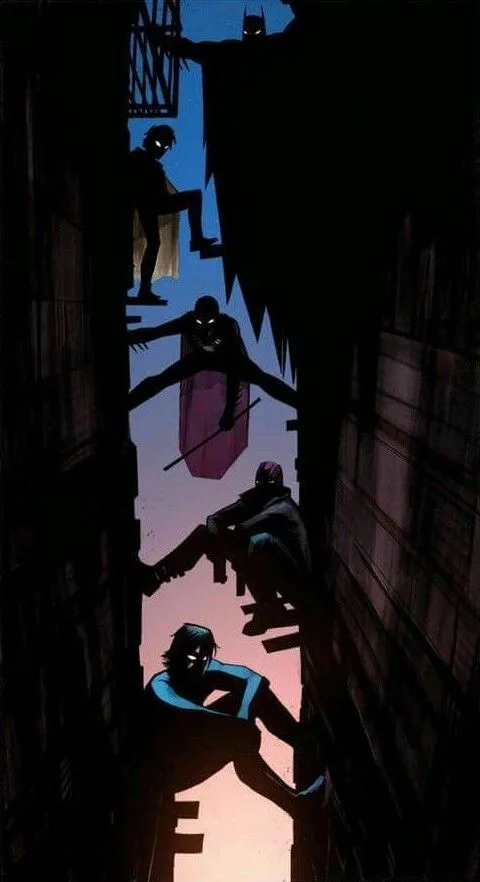
The group usually are seen interacting with one another and assisting in each other's cases in their respective series. When a new vigilante emerges in the city Batman deduces their identity relatively quickly. Although some members occasionally resent Batman’s intrusion into their lives, all respect him as a legend within the superhero community and rarely challenge his authority. Most of the members also have a strong rapport with the Dark Knight due to their long and close relationships with
Characters in this world
Entries
Harley Quinn
Recall Range: 2
Harley Quinn is a character created for the show Batman: The Animated Series. She first appears in the episode "Joker's Favor" and has frequently appeared ever since. She began as Joker's moll and then retconned to be his former psychiatrist at Arkham Asylum. Quinn eventually become a well known Gotham criminal in her own right, frequently working with Poison Ivy on crime sprees she's also revealed to be the future grandmother of Dee Dee. After graduating from college, Harleen Quinzel acquires a job as a psychologist at Arkham Asylum in the hopes of writing a "tell all book" about the super criminals incarcerated there. The Joker immediately piques her interest, and upon approaching him, he quips that her name can be rearranged into "Harley Quinn." Harleen replies that she's heard this before and walks away. She later finds a rose on her desk with an attached note reading "Come down and see me sometime. -J" She returns to Joker's cell and questions how he managed to get the rose in her office. "If you were gonna tell someone, you already would have," Joker retorts. After this encounter, she works for months to set up a therapy session with him. Once finally in the session, Joker recounts a fabricated story of his abusive father beating him as a child. He recalls he only saw his father happy one time and goads her into viewing Batman as the "bad guy" to the point where Harleen despises Batman for constantly hurting Joker. The relationship between Harleen and The Joker becomes more personal over time — until Harley is the one on the couch, talking about her own problems to Joker. She confesses her love to him and he says it's perfectly understandable that she'd want a man who can make her laugh. After an escape from Joker, he is returned by Batman, beaten and bloodied. An infuriated Harleen storms out of Arkham to rob a party favor store, stealing multiple gag items and a costume. She returns to Arkham, in costume, and uses the stolen gag items to incapacitate multiple security guards. Once at Joker's cell, she uses an explosive to open the cell. As the smoke clears, we see Harleen in costume, smiling down at The Joker. She proudly exclaims "Say hello to your new and improved Harley Quinn." Harley escapes with Joker, who maniacally laughs as they speed away from the Asylum in a car. Harley Quinn’s personality in the DC Animated Universe is a chaotic blend of theatrical charm, emotional vulnerability, and unpredictable violence. She’s playful and flamboyant, often using humor and slapstick antics to mask deeper insecurities. Her voice, inspired by Arleen Sorkin’s Brooklyn-accented delivery, adds a layer of bubbly irreverence that contrasts sharply with her darker impulses. At her core, Harley is emotionally driven—loyal to a fault, especially in her toxic devotion to the Joker. This obsessive love fuels much of her erratic behavior, but it also reveals her capacity for deep feeling and tragic self-delusion. Despite being manipulated and mistreated, she clings to romantic ideals, often imagining a fantasy life with the Joker that’s heartbreakingly out of reach. Harley’s intelligence, once channeled into psychiatry, now manifests in cunning schemes and psychological manipulation. She’s not just comic relief—she’s a complex figure whose madness is both performative and sincere. Her journey often explores themes of identity, agency, and emotional survival, especially as she begins to seek independence through friendships like her bond with Poison Ivy. In short, Harley Quinn is the clown who laughs through pain, the lover who breaks her own heart, and the wildcard who refuses to be predictable. Her personality is a kaleidoscope of contradictions—funny, fragile, fierce, and unforgettable. Harley Quinn’s appearance in the DC Animated Universe is instantly recognizable and symbolically rich. She wears a red-and-black jester costume with alternating diamond patterns, a nod to her namesake and her chaotic duality. The full-body suit includes a white collar, black domino mask, and a jester’s cowl with two floppy horns tipped in white pom-poms—playful yet eerie, like a circus performer gone rogue. Her look is deliberately theatrical, evoking vaudeville and slapstick traditions while contrasting sharply with Gotham’s grim aesthetic. The exaggerated costume reflects her performative madness and her role as the Joker’s mirror and foil. Unlike later versions that lean into punk or glam styles, this original design emphasizes symmetry and containment—suggesting a character who’s trying to hold herself together even as she spirals into chaos. Visually, Harley’s animated form is expressive and elastic, often contorting in cartoonish ways that heighten her comedic menace. Her petite frame and acrobatic movements reinforce her unpredictability, while her mask and makeup conceal the vulnerability of Harleen Quinzel beneath the persona. Harley Quinn in the DC Animated Universe doesn’t possess traditional superpowers, but she’s far from powerless. Her abilities are rooted in physical agility, psychological insight, and sheer unpredictability—making her a formidable wildcard in Gotham’s rogues’ gallery. Psychological Expertise: Before becoming Harley Quinn, Harleen Quinzel was a trained psychiatrist at Arkham Asylum. Her deep understanding of human behavior allows her to manipulate others, read emotional cues, and exploit psychological weaknesses—skills she uses both in crime and in navigating toxic relationships. Acrobatics & Combat: Harley is an exceptional gymnast, often flipping, dodging, and contorting her way through fights. Her agility makes her hard to hit and even harder to catch. She’s also skilled in hand-to-hand combat, wielding weapons like mallets, boxing-glove guns, and gag gadgets with surprising effectiveness. Toxin Immunity: Thanks to her close partnership with Poison Ivy, Harley has developed a resistance to most toxins and poisons. This gives her an edge in Gotham’s chemically chaotic underworld, where gas attacks and venomous traps are common. Emotional Manipulation & Theatrics: Harley’s clown persona isn’t just for show—it’s a weapon. She uses humor, charm, and erratic behavior to disarm opponents and confuse expectations. Her emotional volatility can be strategic, allowing her to play victim, seductress, or lunatic depending on the situation. Animal Companions: She’s often accompanied by her pet hyenas, Bud and Lou, who serve as both comic relief and backup muscle. They’re trained to attack on command and add to her chaotic presence. Equipment: Oversized Mallet: Her most iconic weapon, used for both comedic effect and serious damage. It’s a symbol of her brute strength wrapped in cartoon absurdity. Boxing Glove Gun: A spring-loaded firearm that punches instead of shoots—perfect for surprise attacks and visual gags. Pop Guns & Gag Weapons: These include toy-like pistols that fire confetti, gas, or other non-lethal but disorienting effects. They reflect her clownish persona and love of mischief. Joke-themed Explosives: Occasionally, Harley uses bombs disguised as presents or toys, often laced with gas or knockout agents. Toxin Resistance: Thanks to Poison Ivy’s intervention, Harley has developed immunity to many poisons and toxins, allowing her to operate in chemically hazardous environments. Bud and Lou: Her trained pet hyenas serve as both muscle and comic relief. They respond to her commands and add unpredictability to her confrontations. Costume & Persona: Her jester outfit isn’t just for show—it’s a psychological weapon. The exaggerated visuals disarm opponents and mask her true intentions. Manipulative Tools: Harley often uses disguises, props, and emotional theatrics to manipulate others, especially in schemes involving seduction or deception.